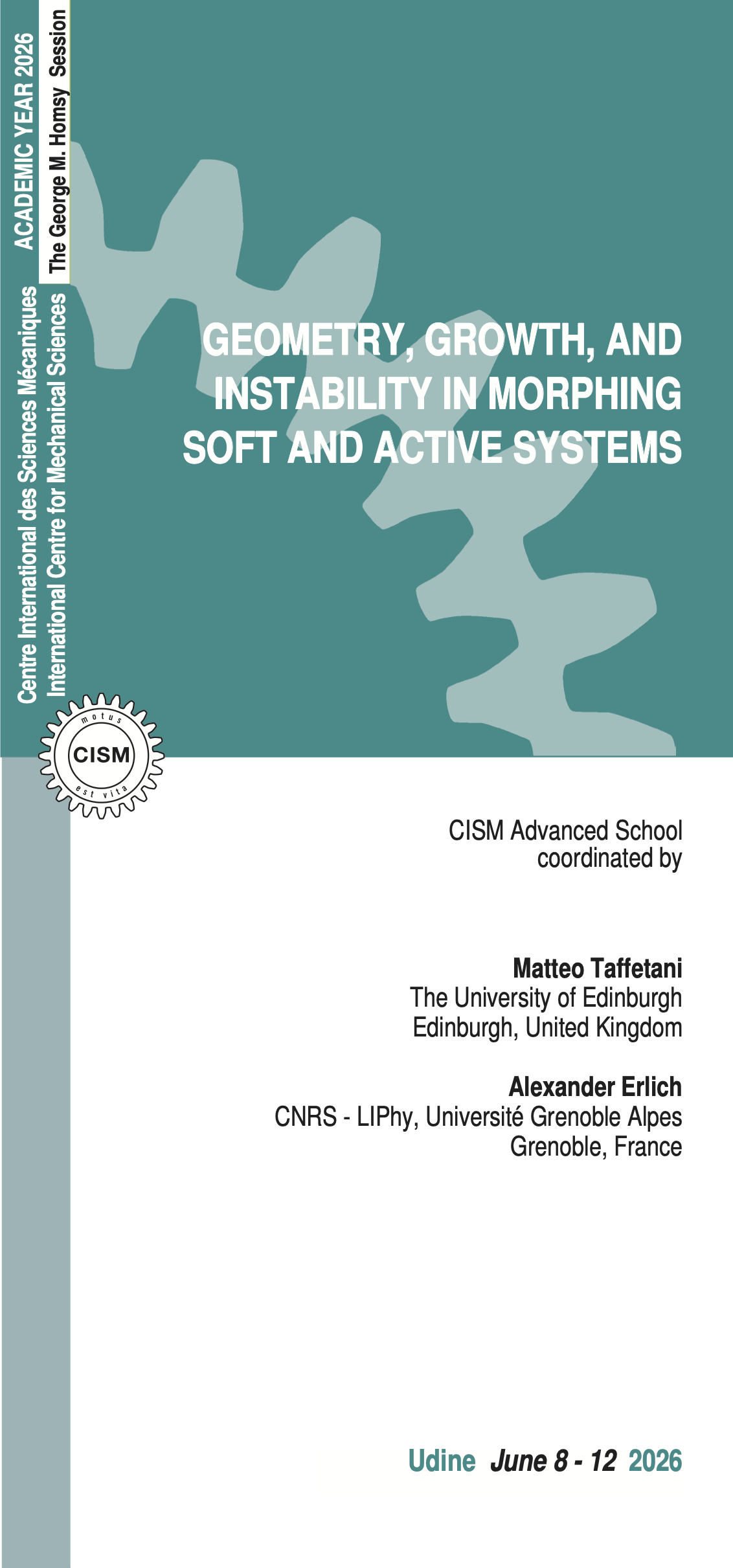
Morphing, intended as the ability of a system to change its shape, is a phenomenon that appears in a variety of contexts, from biological tissues and soft materials to swelling gels, active matter, and engineered structures. A common question associated with morphing is how such systems reach, maintain and dynamically transform their shapes when non-mechanical stimuli interact with their inherent mechanical elastic response. In other words, the challenge associated to morphing is to understand how forces, geometry and internal fields couple to regulate shapes and sizes. Addressing these mechanisms not only deepens our understanding of natural systems but also guides the design of controllable, programmable artificial morphing materials.
The course aims to present a coherent framework for modelling morphing in soft, biological and active systems across scales, combining continuum and discrete descriptions. It covers the mathematical foundations of modelling approaches and their mechanical implications via the application to a range of case studies.
In the three-dimensional setting, the course introduces the general continuum framework where the stimuli–feedback mechanism is treated via the multiplicative decomposition of the deformation gradient tensor. Growth laws consistent with thermodynamics are derived for both bulk and surface growth and the role of curvature, as a measure of incompatibility and as a mechanism for generating residual stresses and size regulation, is highlighted in examples as the evolution of tumour spheroids and 3D printing. The course discusses swelling, presented as a chemo-mechanical coupling between elasticity and transport, as a morphing mechanism responsible for large shape changes, transient instabilities and pattern formation in gels and biological tissues. Furthermore, the course introduces how to include, phenomenologically, an active description into an effective constitutive relationship to model active metamaterials.
The course presents dimensional-reduction approaches, based either on energy expansions or on reduced equilibrium equations, as effective tools to derive how the three-dimensional descriptions transform into geometric nonlinearity, bending–stretching interactions and incompatibility for slender structures. These theories explain morphing phenomena such as vesicle formation, snapping and wrinkling in rods and shells.
To address morphing strategies in biological contexts, the course links the continuum description to the discrete behaviour of cells. Vertex and tension-based models illustrate how cellular mechanics give rise to effective tissue-level laws, including active responses. Mechanosensing, active stress generation and active nematic concepts provide a framework for collective flows, defect dynamics and turbulence in epithelial layers and bacterial colonies, offering a consistent picture of how local activity and geometry shape morphogenesis.
The course is aimed at doctoral students, postdoctoral researchers and other early-career scientists interested in the mathematical and physical foundation of morphing strategies in three-dimensional, slender and cellular systems.
M.J. Bovyn and P.A. Haas.Shaping epithelial lumina under pressure, Biochemical Society Transactions, 52(1):331–342, (2024).
P. Nardinocchi, L. Teresi, and D. P. Holmes. Mechanics of Swelling, Royal Society of Chemistry, 2026.
M. Curatolo, P. Nardinocchi, and L. Teresi. Dynamics of active swelling in contractile polymer gels, Journal of the Mechanics and Physics of Solids, 135:103807 (2020).
A. Erlich and G. Zurlo.Incompatibility-driven growth and size control during development, Journal of the Mechanics and Physics of Solids, 188:105660 (2024).
A. Erlich and G. Zurlo. The geometric nature of homeostatic stress in biological growth, arXiv:2412.16021 (2024).
S. Höhn, A.R. Honerkamp-Smith, P.A Haas, P. Khuc Trong and R.E. Goldstein. Dynamics of a Volvox embryo turning itself inside out, Physical Review Letters, 114(17):178101 (2015).
C.M. Nelson. On buckling morphogenesis, Journal of Biomechanical Engineering, 138(2) (2016).
M. Taffetani and M. Pezzulla. Nonlinear morphoelastic energy based theory for stimuli responsive elastic shells, arXiv:2511.10324 (2025).
G. Zurlo and L. Truskinovsky. Printing non-euclidean solids, Physical Review Letters, 119(4):048001 (2017).
W. Simpkins, M.G. Hennessy, M. Taffetani. Snap-through time of arches is controlled by slenderness and imperfections, arXIv:2508.10802 (2025).
Andersen, B.H. et al. Evidence of universal conformal invariance in living biological matter, Nature Physics. 21: 618-623 (2025).
Andersen, S.G. et al. Anti-hyperuniform critical states of active topological defects, Reports on Progress in Physics, 88:108101 (2025).
6 lectures on:
Mechanosensing and active stress generation in cells; active nematics and defect dynamics in tissues and bacterial colonies; flows, turbulence and confinement-driven patterning; applications to epithelial morphogenesis, collective cell migration and self-organisation in active multicellular systems.
6 lectures on:
Residual stress in morphogenesis, nonlinear elasticity, multiplicative decomposition, growth laws, thermodynamic restrictions, incompatibility, homeostatic stress, geometric elasticity, Ricci curvature, Drosophila wing disc, multicellular spheroids, Pacman opening patterns.
6 lectures on:
Mechanical instabilities in elastic sheets (buckling, wrinkling, creasing); emergent continuum mechanics of epithelial tissues from coarse-grained discrete models; applications to epithelial morphogenesis: biophysics of gastrulation and of lumina.
6 lectures on:
Dimensional reduction of morphoelastic solids (energy- and equilibrium-based); nonlinear plate and shell theories; snapping and morphing in slender structures; vesicle formation in non-Euclidean shells; stimuli responsive plates theory to model of active metamaterials.
6 lectures on:
Chemo-mechanical models of swelling in soft heterogeneous materials; coupling elasticity with solvent transport; transient swelling instabilities and wrinkling; optimisation of growth metrics for programmable bio-inspired shape change.
6 lectures on:
Surface and volumetric growth; non-Euclidean growth; micro-displacement tensor; incompatibility and residual stress; vertex models; biological growth; solidification; additive manufacturing.
ADMISSION AND ACCOMMODATION
The course is offered in a hybrid format, allowing participants the flexibility to attend either in person or remotely via the Microsoft Teams platform.
Admission to on-site attendance is granted on a first-come, first-served basis to comply with the capacity of the lecture room.
Registration fees:
- Early Bird On-Site Participation: € 650.00 + VAT* - Deadline: April 8, 2026
- Late On-Site Participation: € 800.00 + VAT* - Deadline: May 29, 2026
- Live Streaming Online Participation: € 250.00 + VAT* - Deadline: May 29, 2026
On-site participation includes a complimentary bag, five fixed menu buffet lunches, hot beverages, downloadable lecture notes.
Online participation includes downloadable lecture notes.
Application forms should be submitted online through the website: http://www.cism.it. A confirmation message will be sent to participants whose applications are accepted.
Upon request, and subject to availability, a limited number of on-site participants can be accommodated at the CISM Guest House for € 35 per person per night. To request accommodation, please contact foresteria@cism.it.
CANCELLATION POLICY
Applicants may cancel their registration and receive a full refund by notifying the CISM Secretariat in writing (via email) no later than:
- April 8, 2026, for early bird on-site participation;
- May 8, 2026, for late on-site participation;
- May 29, 2026, for online participation.
No refunds after the deadlines. Cancellation requests received before these deadlines and incorrect payments will be subject to a € 50.00 handling fee.
GRANTS
A limited number of participants from universities and research centers who do not receive support from their institutions can request a waiver of the registration fee and/or free lodging.
Requests should be submitted by email to the CISM Secretariat at info@cism.it by April 8, 2026. Submissions must include the applicant’s curriculum vitae and a letter of recommendation from the head of the department or a supervisor, confirming that the institute is unable to provide funding. Preference will be given to applicants from countries that sponsor CISM.
Please send an email to: secr.general@iawe.org for questions on application.
coming soon courses
 Fluid-Structure Interaction of Bioinspired Systems
 Rilievo Architettonico con Droni: Metodologie e Applicazioni Fotogrammetriche
 11th CISM-ECCOMAS Advanced course on "Parameter Identification Using Full-Field Measurements"
 CISM-EUROMECH Advanced Course on "Fluid Mixing: Fundamentals and Practices"
 Filtered Modelling Approaches for Industrial Gas-Particle Suspensions: Basics and Future Developments